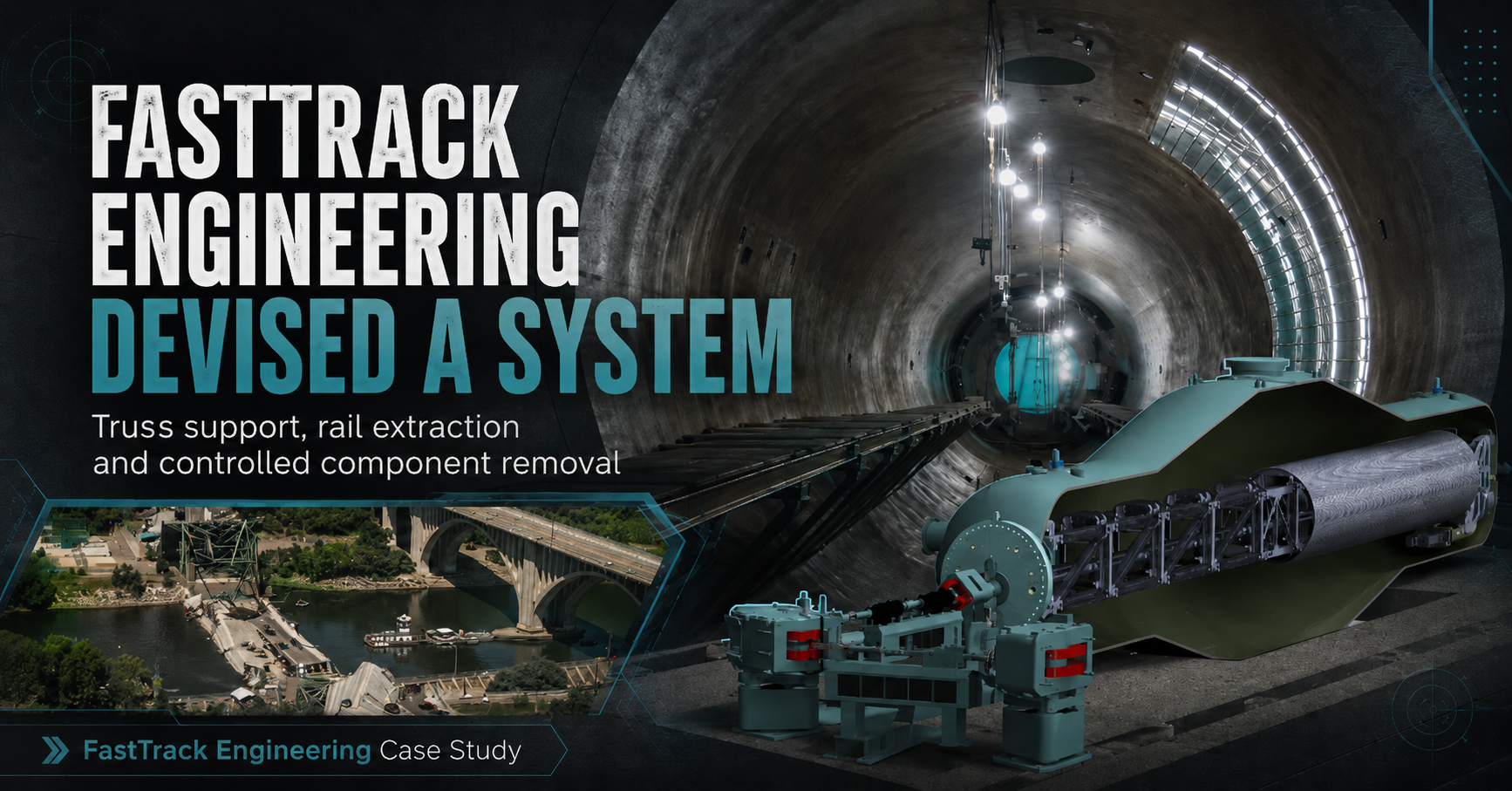
The University of Minnesota tandem linear accelerator removal was not a standard demolition project. FastTrack Engineering devised the support and rail extraction system used to remove complex internal components from the Tandem Linear Accelerator after the University of Minnesota decommissioned its accelerator laboratory.
The challenge was not just the size of the equipment. The internal assembly was built with stainless steel and glass components, held together under compression, and had to be removed in a controlled sequence before the pressure vessel and building could be demolished.
FastTrack Engineering’s Tandem Linear Accelerator Removal Solution
FastTrack Engineering devised a system of truss support and rail extraction to remove internal accelerator components safely. The goal was to preserve key parts for use as spares in the remaining Tandem Linear Accelerators of this design around the world.
This required more than a lift plan. It required a controlled removal system that addressed stored force, fragile components, and step-by-step disassembly inside the vessel.
Why the Tandem Linear Accelerator Removal Was So Complex
The Tandem Linear Accelerator included an acceleration tube inside a supporting truss structure, all housed within a stainless steel tubular tunnel. The internal components were made from layers of stainless steel plates and glass.
These components formed the chords of the truss and acceleration tube, but they were not designed to carry tensile loads of any significance. Instead, the truss assembly was held under compression with a hydraulic jack and spring mechanism.
The system was locked in place with up to 50 tons of force. If that compression force was released incorrectly, the vessel could fill with shards of glass and stainless steel. That made the removal process a serious engineering challenge.
How FastTrack Engineering Controlled the Removal
FastTrack Engineering developed a controlled sequence to support the truss, release compression, and remove the internal components piece by piece.
The removal plan included:
- A custom rail extraction system for internal component removal
- Truss support hangers installed from the roof of the vessel
- Hydraulic rams to remove compressive force from the truss structure
- A controlled unpinning sequence for individual truss chords
- Cart-based removal of truss chords on the rail system
- Rigging from inside the vessel to control each component during removal
The Step-by-Step Accelerator Removal Process
-
Remove the Target End Flange
The project began by removing the target end flange to create access for the internal removal work. This step opened the vessel for the custom rail extraction system.
-
Install the Custom Rail Extraction System
FastTrack Engineering used a custom rail extraction system to remove acceleration tubes and other internal components from inside the vessel. This gave the team a controlled path to move components out safely.
-
Install Truss Support Hangers
Truss support hangers were installed from the roof of the vessel. These hangers helped support the internal truss structure while the stored compression force was removed.
-
Release Compressive Force With Hydraulic Rams
Hydraulic rams were used to remove compressive force from the truss structure. This was one of the most important parts of the tandem linear accelerator removal because the internal components had to remain controlled during disassembly.
-
Unpin and Remove Truss Chords
The truss chords were unpinned and removed individually. Each chord was rigged from the roof of the vessel, loaded onto a cart, and moved out on the rail system.
-
Gut the Vessel Before Demolition
Once the internal components were removed, the vessel was gutted. The pressure vessel housing and the building were then demolished after the critical components had been safely extracted.
Why Component Preservation Mattered
This project was not only about taking equipment apart. The internal components were removed for use as spare parts in the remaining Tandem Linear Accelerators of this design around the world.
That made the work more complex. FastTrack Engineering had to plan for removal, support, preservation, and demolition sequencing at the same time.
What This Project Shows About Engineered Removal Planning
The University of Minnesota tandem linear accelerator removal shows why engineered planning matters on complex industrial projects. When equipment contains stored force, fragile components, confined access, or unusual support conditions, the removal plan has to answer the hard questions before work begins.
FastTrack Engineering supports complex rigging, engineered lift planning, equipment removal, machinery moving, and custom project solutions where standard methods are not enough.
For complex engineered removal planning, visit FastTrack Engineering or call 815-467-7187.
Frequently Asked Questions
What is tandem linear accelerator removal?
Tandem linear accelerator removal is the process of safely removing accelerator equipment, internal components, support structures, and pressure vessel elements from a decommissioned accelerator system.
Why was the University of Minnesota accelerator removal difficult?
The internal components were made with stainless steel and glass and were held under compression. Releasing that force incorrectly could have caused the vessel to fill with shards of glass and stainless steel.
What did FastTrack Engineering design for this project?
FastTrack Engineering devised a truss support system and rail extraction system to remove the internal components in a controlled sequence.
Why were hydraulic rams used?
Hydraulic rams were used to remove compressive force from the truss structure so the internal accelerator components could be safely disassembled and removed.
Why were the internal components preserved?
The components were removed for use as spare parts in the remaining Tandem Linear Accelerators of this design around the world.
When does a project need engineered removal planning?
Engineered removal planning is important when a project involves stored force, fragile components, confined spaces, heavy equipment, custom rigging, unusual support conditions, or demolition sequencing.